Tired from Nothing? RSD, Executive Dysfunction, and the Coming Year
- nolanlind

- Dec 14, 2025
- 12 min read
Updated: Dec 14, 2025
List of Chapters:
Subtle Foreshadowing
Dopamine Machine Broke
*More than Squirrels and Shiny Objects, Unfortunately
Eating My Vegetables
*Do It, or Don’t
*If you read nothing else, at least read these sections.
Recommended Listening:

1: Subtle Foreshadowing
I don’t watch most movies or series when they’re released or trending. Granted, there is an overabundance of movies and series siloed on too many streaming platforms to track; and if not as group outings with my family, at some point movies became partner activities to me. After a harrowing past few months to several years, I am closing out yet another year without a partner. I do, however, have an affinity for horror, especially the paranormal and supernatural. I attribute this affinity to family gatherings growing up where the adults reminiscing together turned into telling stories about strange and scary things that happened to them while they were growing up themselves.
Respect for my elders is ingrained into both sides of my heritage and upbringing. Me or anyone feeling anything about the past doesn’t change the fact that it happened, or how traumatic it might’ve been for them at the time. But even now, I walk a fine line between wishing I was more perceptive of the supernatural, and knowing how dangerous it can be to wish for that. It’s one thing to hear about it from other people, but it’s an entirely different matter when it happens to you.
By my observation, one of the most common horror fiction character tropes or archetypes is the main character or protagonist that nobody believes at first. Unexplainable and increasingly negative things happen as the plot advances that only the protagonist experiences. These experiences begin taking a mental and physical toll, which is when others might take notice. When pressed about it, the protagonist tries to explain what is happening (when they hardly understand it themselves) only for nobody to believe them. The protagonist might then join others in dismissing and internalizing their own experience as “nothing.” Hardly anyone notices or gives them the support they need until the forces at work start to affect other people - or in worse cases, until after it’s too late for the protagonist.

2: Dopamine Machine Broke
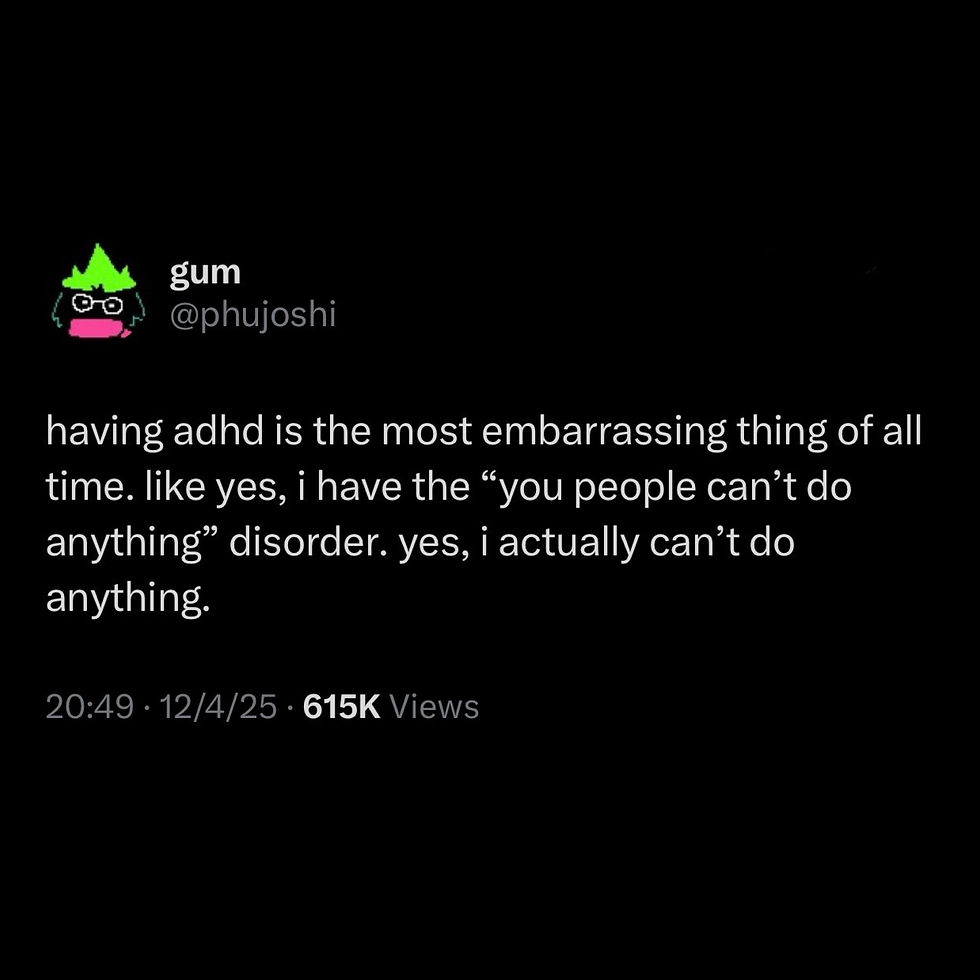
I will bring it up every chance I get: I was diagnosed with inattentive-type ADHD in September of 2022. Theories abound about how an ADHD phenotype like mine is not an evolutionary “bug,” but rather a biological “feature” of hunters from the days of hunters and gatherers: hypervigilant senses to monitor surroundings, and the capacity for hyperfocus to see urgent tasks through to their end - with the latter usually coming at the expense of remembering to eat, drink, or even use the bathroom.
Other neurodivergent superpowers I gain with this condition include out-of-the-box thinking, an above-average capacity for memory and pattern recognition, and processing information faster than most neurotypical people. Each blessing of a superpower, however, is also a potential curse. But like with most other hot-button social issues, people might say “more research is needed” about ADHD. And like with most other hot-button social issues, I believe that however earnestly anyone does or cites the research, most people will still refuse to believe it.
Hearing about the hunter-gatherer theory helped me realize that I’ve been living in a near-permanent state of fight-or-flight mode. Before I recognized this, I would’ve described it as feeling “on-call” to keep an eye and ear out in case I was needed, or in case I was next. Everything in recent memory has felt urgent and high-stakes, like neverending fires to put out immediately because I wasn’t always afforded time or notice to transition from one task to another. Things seeming okay only to suddenly find out that they aren’t, has also been a huge contributor to this. Not fulfilling someone else’s asks, even just saying “no” when I know I’m at my limit, feels like a moral failure from which there is no recovery.
Different tasks require different modes of thought, and constantly transitioning between them is where I now find myself exhausted. Living with my condition means reckoning with my own exhaustion while also sensing (projecting) the emotions of other people. Without boundaries, feeling other people’s emotions becomes compassion fatigue. When left unchecked, out-of-the-box thinking and pattern recognition become overthinking, and quickly processing information can become misinterpreting people’s words. As a result, I’m prone to hurting my own feelings while misunderstanding and misleading other people.
As optimistic or realistic as I might have been before, I’ve also since developed a tendency for adamant pessimism. Thoughts, feelings, opinions, judgements of people including myself, states of being - everything negative feels like a personal responsibility and carries the potential of permanence beyond repair. For every best-case scenario I can imagine, I can come up with more worst-case scenarios. As real as they feel, hardly anything from these scenarios comes to pass, if they are even founded in reality or not. To know that all of this is happening when it doesn’t have to be, feels like being spiritually possessed by the worst versions of myself.
Medically, my condition is a neurodevelopmental disorder and neurotransmitter imbalance that affects the parts of my brain responsible for emotional regulation (clearly) and initiating movement - among other parts and functions, I’m sure. ADHDers are not a monolith (or however the saying goes), and I don’t claim to be an expert or authority on anything. But moments like when I sit in the parking lot of grocery stores, procrastinating unbuckling my seatbelt because I already expended energy to leave the house, can be chalked up to what is called executive dysfunction. The key difference between executive dysfunction and laziness is that being lazy would mean enjoying doing nothing. In my current state, I would love to enjoy anything, especially doing nothing.

3: More than Squirrels and Shiny Objects, Unfortunately
In 2025 I’ve plumbed new emotional depths and reached new mental lows. Not necessarily from recent catastrophe or even anything physical, but more because of what I now recognize as the after-effects of years of loose ends from living day to day. These loose ends were left unaddressed, unprocessed, and unresolved, because I was too busy either dealing with other people or anxiously waiting for the next shoe to drop. Until now, I’ve felt pressured to “mask” by powering through and pretending that I was okay when that wasn’t always true. Now I recognize that I’ve been going through life’s motions, performing being a person at a bare minimum for everyone else’s sake, and leaving scraps for myself. I’m at a loss for how else to word it but I don’t expect anyone to believe it, either. It might look and sound like “nothing,” but it doesn’t feel like it to me.
After three years of being diagnosed, I believe that other people still dismiss ADHD as little more than being forgetful, messy, easily distracted, annoying, tired, lazy, or moody for no good goddamn reason - never real despite being an ADA-designated disability, never an explanation, and an excuse that is never good enough. No one sees how much I’m invalidating and therefore abandoning myself so that others don’t abandon me. No one sees that I’m fighting a constant war against myself that shouldn’t have to be fought.
One of the most common hallmarks of (my) ADHD is performing exceptionally well in primary and secondary academic settings before other symptoms start creeping in. Spending the formative years of my life being held to above-average standards meant just as much celebration as it did criticism. If I was so smart, why couldn’t I focus, apply myself, learn things quickly, finish my work, or score higher grades? I didn’t know at the time that I was growing up in a world that wasn’t built to accommodate someone like me, and neither did the adults in my life because it wasn’t as widely researched then. Mobile internet also hadn’t come to rural Alaska yet. I also didn’t know that I was failing to meet standards because they weren’t my standards to meet. A child student that performs at a college level is still a child.
My (selectively) foolproof memory means I still feel and carry the weight of a lifetime of criticism and negative reinforcement, in addition to the marginalization I still face for being “different.” When combined with hypervigilance and amplified emotions, shifts in others’ energy in conversation can start me wondering what I did wrong. Trauma with negative reinforcement and weirdly indirect neurotypical communication means I now have a habit of creating accountability to take, apologizing for things that aren’t even mine to apologize for - especially when no one else will, and especially when people seem more interested in placing blame than finding solutions. As noble or performative as this habit might be, any suggestion of rejection now feels like a final-word condemnation of character. This is what I think the colorfully-illustrated self-help pages on social media call rejection-sensitive dysphoria, or RSD for short.
Operating on such an intensely negative self-image can circle around to looking like I think I’m too good for anything or anyone. In reality I barely think I’m good enough to be seen by most people, much less not look at the ground when I’m walking anywhere. Having been steeped in this sense of perceived rejection for so long, I’m convinced that I’m everyone’s enemy by default until I’m proven otherwise. I don’t see my coworkers outside of work. I hardly see or speak to my friends, and I barely leave my bedroom, much less the house. If I can’t love or be loved, I can be useful - but if I can’t be useful, I see no point.
Living with my family continues to be a blessing and a privilege, but the fact that I’m still here after 8 years (and counting!) as an adult in my mid- to late-30s means I think they resent me being here, when in reality I only resent myself. Knowing that I’m not who, what, or where I can be in life feels like the world is mad at me for that, when I’m only mad at myself because I think other people are.

4: Eating My Vegetables
Watch any vertical-frame interview on social media about relationships with couples walking through the streets of a major city, and couples that have been together for many years are guaranteed to be asked: what is the secret to staying together for so long? To know and accept is to love, to be known and accepted is to be loved, and to know and accept yourself is to love yourself. I’m 36-plus years into this relationship with myself. However dysfunctional, and my own heinous lack of self-acceptance aside, it is still the longest-running relationship I’ve had with anyone.
Without a family of my own to raise or a house payment to make, self-care comes easy when your “self” is all you have like I do. Burning through bubble bath, face masks, extravagant meals, and my streaming content of choice as quickly as I do, I’ve found that distractions as superficial as these are only slightly less important than making sure my actual needs are met. One among these needs is actively monitoring my finances, especially in a world powered by finances. In therapy I would call this the emotional equivalent of eating my vegetables: not something I do for fun or flavor, but rather for long-term benefit.
I am a byproduct of the western public education system in rural southwest Alaska from 1994 to 2007, and I’ll admit that I don’t think my education prepared me for much in practical adulthood. I did, however, grow up learning how to use computers, getting my start with playing Thinkin’ Things in our computer labs in the first grade. When I was old enough to open a checking account, I blew through the graduation money I used to open it in no time. I survived three years of college on scholarships that I barely qualified for, and on money out of my parents’ pockets because I was too spoiled and lazy to work a job on campus. In my defense, I was also too anxious and socially inept to work in food service or retail, and all the basic office or office-adjacent jobs on campus were taken - and I didn’t have transportation beyond the city bus.
Once I got my first paying job slinging medical records at the hospital back at home between college semesters, I fell into the habit of blindly spending my paychecks until my debit card declined. Once I left college and started working full-time, I started using spreadsheets to track my spending, creating one for each paycheck. Moving from Dillingham to Anchorage, my paychecks went from bi-monthly on varying but specific days to bi-weekly on a regular basis, meaning each spreadsheet grew longer because I had a better idea of how much I was getting paid and when. In essence these spreadsheets started as keeping my checkbook balanced while just watching my money being spent. Now, the one spreadsheet that I keep is a multi-page document that spans from its creation in 2023 to the end of 2026 and potentially beyond. I use it to monitor spending and track my debts in detail as much as I use it to plan ahead - “budgeting,” as people might call it.
Most people in creative pursuits are told how much happier they will be creating for themselves or for their own sake. My writings like this are vehicles for mass life-updates, but they’re also tools for averting or de-escalating crises. As necessary as these writings are, and as much as I write these for my sake, what I write about could also mean uncovering the worst parts of myself and my past - often reliving potentially painful memories as if they just happened - for hours at a time until I’m drained beyond thinking anymore. Similarly, the longer I look at this budget spreadsheet, the more I can despair at any number of things: that I’m broke now, that I will be broke again later, that I was never as disciplined with money as I should have been, that it’s going to take so long to reach any specific goal, or that it’s pointless to have a goal at all.
5: Do It, or Don’t
As I approach my late 30s, and the more generally tired I become, the less interested I am in existing online and having a digital footprint. I’m also weirdly superstitious about sharing explicit goals now. Sharing anything can create too much visibility and vulnerability, and I don’t think I’ve done the best job thus far keeping my heart or mind protected. With the advent of social media also comes a sense of obligation to keep everyone updated. Should anything change, in my condition I see my disappointment becoming others’ disappointment before becoming mine again and multiplying.
If not as sitting in the parking lots of grocery stores, another form of ADHD paralysis that I experience is that if I have an appointment, I will feel compelled to wait to do anything else until after that appointment is complete. I wait because I worry about getting sidetracked and taking longer to do anything else than I might originally plan. I have made, contemplated, and changed plans with my budget spreadsheet multiple times over the past few years. I sat and stared at numbers on a screen, agonizing the whole time about how moving them around would affect how the coming year(s) would play out. Now my goals are clearer than ever to pay down my debts and save for another rental deposit or a mortgage down payment.
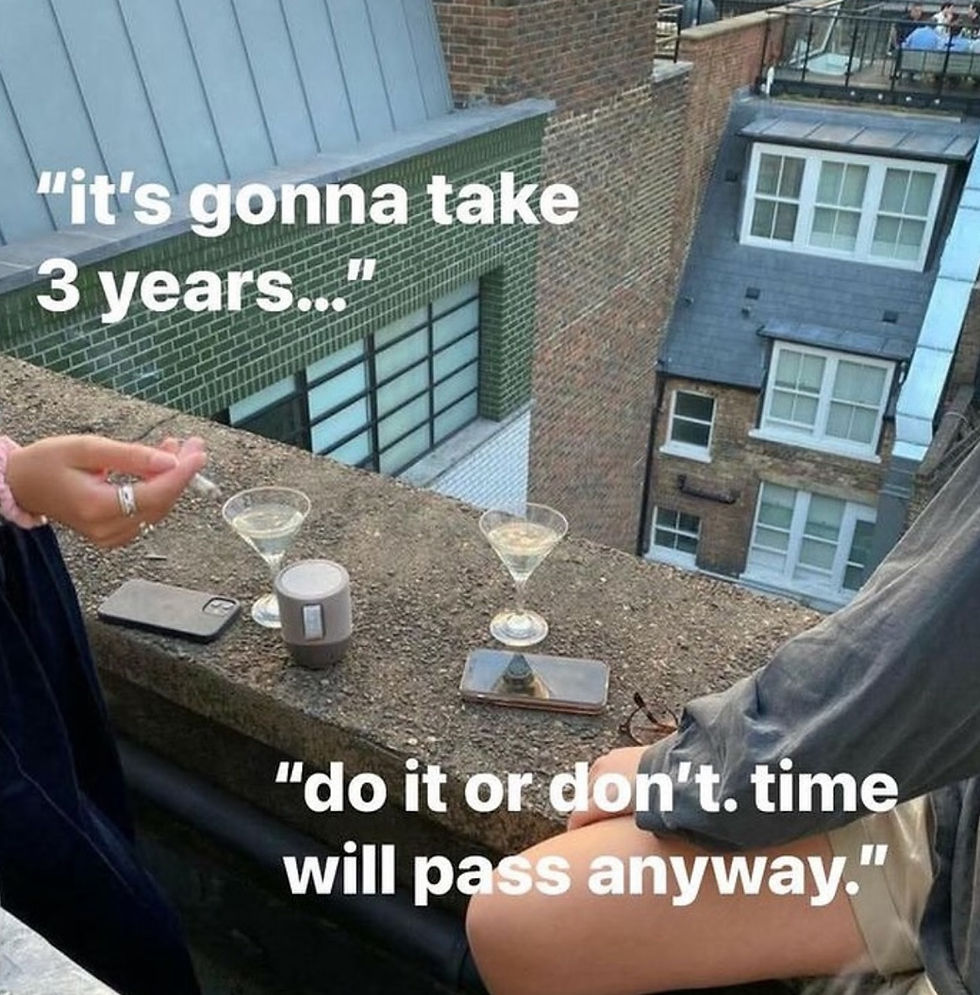
I came across a quote online recently: “do it, or don’t; time will pass anyway,” which I found more helpful than “tempus fugit,” or “time and tide tarry for no man.” I’ve come to accept that time seems to pass more quickly with age because where six years span the entirety of a six-year-old’s life, they span one-sixth of a 36-year-old’s life, and the fraction can only continue shrinking. My lowest points this year have shown me how vital it is that I reach those goals as soon as I can. This latter form of ADHD paralysis also means that now that I have a goal, my only instinct is to wait.
A nervous system stuck in fight-or-flight mode craves safety. To me in this case, safety means calm but clear communication, no expectation to do anything especially for anyone else without advance notice (even a five-minute warning helps with my mental transitions), no pressure to socialize in person, and no demand to be physically present - especially at times like this when mentally and emotionally, I am not. The best example of this safety in action that I have is how much better I sleep if I’m vacationing out of town. My personal best is 15-plus hours after my best friend and I reached his family’s cabin in the Yukon one summer.
Everything is temporary. Thoughts and feelings are visitors that can only pass through. We are not our thoughts, but rather observers of our thoughts - but me thinking all of this feels like putting words in people’s mouths on a cosmic scale. I’ve mostly stopped mindlessly scrolling through social media, but I’m still best reached on any messaging platform. Physically keeping an ear out often means hearing things not meant for me, creating stress that I don’t need to create. Waiting in this case also means getting comfortable exercising my creativity again, among other long-neglected side quests - so I won’t just be sleeping through the foreseeable future, as much as I want to.
Asking for any kind of help is as much a sign of strength as it is a display of vulnerability that I’ve found can be embarrassing. These feel like an impossible ask from other people, but I’m ready to give myself time, patience, grace, and understanding. I just need a break for at least the next year, before the break takes me and becomes a breakdown.
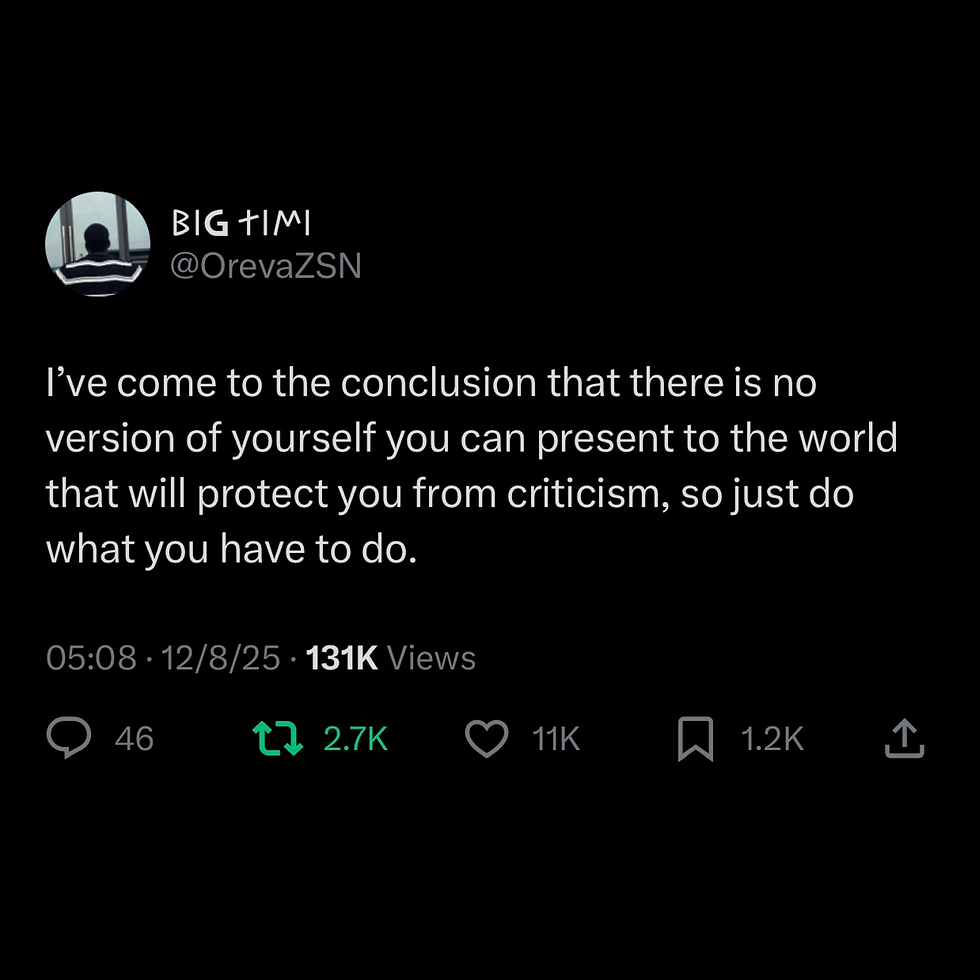
Bonus dump of pertinent memes:



You got a great gift for writing. Thank you for sharing from your heart, it gives me better understanding as your parent. We love you so much.